

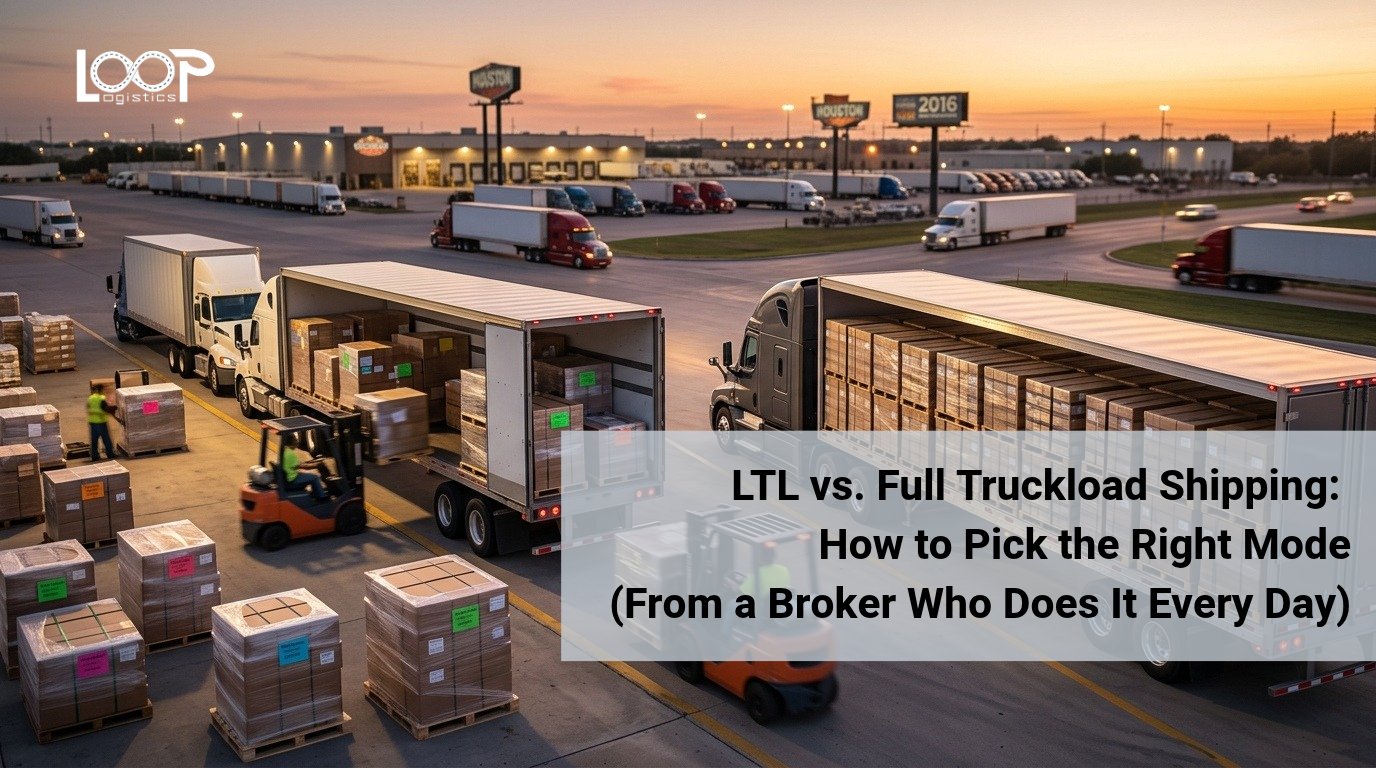


If you ship freight, you’ve run into the question sooner or later: should this move go LTL (less-than-truckload) or FTL (full truckload)? The textbook answer is simple. The real-world answer, the one that actually protects your budget and your deadlines, is not.
At Loop Logistics, we’re a Houston-based freight brokerage that’s been booking both modes since we opened our doors in 2016. Our freight splits about 70% full truckload and 30% LTL, and we move some freight that leaves no room for error, including trade show and exhibit shipments on strict move-in clocks, produce, steel, lumber, and even beehives for pollinators. That mix has taught us that the cheapest line on a quote is often not the cheapest shipment once it’s delivered.
Here’s how we think about the decision, with real numbers from our own lanes.
The short version: what LTL and FTL actually mean
LTL means your freight shares a trailer with other shippers’ freight. You pay for the space your pallets take up, not the whole truck. It’s built for smaller shipments, and it moves through a hub-and-spoke network of terminals, which means your freight gets handled, unloaded, and reloaded along the way.
Full truckload means you book the entire trailer. One shipper, one truck, usually one pickup and one delivery. You pay for the whole 53 feet whether you fill it or not, and in exchange you get control: no terminal hops, no co-loading, and a schedule you can lock down.
That handling difference is the whole ballgame. Everything below comes back to it.
How we decide: the questions we actually ask
When a customer isn’t sure which mode they need, we don’t start with price. We start with the freight and the timeline:
- How many pallets, what size, and what weight? This is the baseline. A handful of standard pallets is LTL territory; once you’re filling most of a trailer, full truckload usually wins.
- Are your transit times flexible? LTL moves on the carrier’s network schedule, not yours.
- Do you have a flexible receiving window? If a dock appointment is tight, terminal delays become your problem.
- Is the freight fragile, high-value, or sensitive? If you don’t want your cargo sharing a truck and getting handled multiple times, that’s a reason to book the whole trailer even when LTL looks cheaper on paper.
Notice that only one of those questions is about size. The others are about risk and control, and that’s where most shippers get surprised.
A real trade-off: when paying more was the smart move
A freight forwarder had three separate LTL shipments sitting in Indianapolis, all headed to their dock in the Houston area. Booking all three as LTL would have run about $2,600. But they wanted control and a set pickup and delivery window, so they asked about consolidating.
We booked a single dedicated 53-foot van at $3,000, roughly $400 more than the LTL option. For that difference they got next-day pickup, Monday delivery, and warehouse-to-warehouse service straight to their dock on one truck with a consolidated bill of lading. No terminal handling across three shipments, no three sets of appointment risk, one schedule they could plan around.
That’s the real LTL vs. truckload decision in a nutshell: sometimes you pay a little more truckload money to buy timing and control that LTL simply can’t guarantee.
The hidden costs that make “cheap” LTL expensive
Here’s the thing most shippers learn the hard way: the LTL quote is not the all-in number. A few patterns we see constantly:
- Accessorials add up fast. On one Illinois-to-Texas exhibit move, a straight truck with a liftgate ran about $1,875, while the LTL base looked like $880 to $955. But add the liftgate at delivery, plus residential or appointment fees, and that gap closes quickly. Forget to declare those accessorials up front and you get sticker shock on the invoice.
- Volume weight vs. actual weight. On a trade show move from the Dallas–Fort Worth area to an Oklahoma City convention center, the freight actually weighed around 617 pounds, but the volume (density) weight came out to roughly 1,482 pounds. When the client told us the freight was non-stackable, the cheap LTL assumption fell apart, and we moved it to a dedicated truck at $1,100 instead.
- Some freight can’t go LTL at all. A milling machine, a non-stackable load, or freight with no dock and no liftgate may need a flatbed or step deck. If you quote it LTL, you quoted the wrong mode, and the number was never real.
If you’re shipping exhibit freight, see how we handle move-in deadlines and marshaling yards on our trade show freight services page.
Trade show and exhibit freight: where mode choice gets unforgiving
This is our specialty, and it’s where the wrong mode gets expensive fast. When there’s a hard move-in time, a booth number, a marshaling yard, or a labor crew on the clock, we lean dedicated almost every time. Miss your window on an LTL shipment, between terminal hops and weak appointment control, and you don’t just pay for the freight. You can eat labor penalties, a missed install, or the cost of scrambling an emergency dedicated truck at the last minute.
We’ve seen detention pile up at pickup, yard time at the venue, and show-to-show moves where timing was everything. LTL still has its place here when the pieces are small and the timing is genuinely flexible, but when the labor clock is running, control wins.
The freight that should never share a truck
The same rule we use for trade show freight applies to anything fragile, high-value, non-stackable, or booked for exclusive use: if it can’t survive terminal handling and co-loading, keep it out of the LTL network. That’s as true for sensitive and live freight as it is for a timed booth shipment. When the downside of damage or delay is bigger than the savings, the whole trailer is cheap insurance.
Don’t forget the middle option: partial truckload
LTL and full truckload aren’t the only two choices, and this is where a good broker earns their keep. Partial truckload is for freight that’s outgrown cheap LTL cube but doesn’t need a full empty 53-footer. We use it constantly, for example consolidating two exhibit shipments from Phoenix to Indiana onto a single partial truck. It gives you fewer handling touches than LTL without paying for air in a full trailer.
Between partial truckload, our vetted carrier network, and our sister trucking company’s own fleet for lanes where we want dedicated capacity and tighter control, there’s almost always an option between “cheap and risky” and “expensive and overkill.”
The biggest misconception: “LTL is always cheaper”
It isn’t. The cheapest LTL line is not the win if your freight is non-stackable, time-sensitive, or accessorial-heavy. The honest comparison is all-in cost plus risk. We’ll happily put a $1,100 dedicated option next to a $608-plus-accessorials LTL option and let you choose, because once you see the real numbers side by side, “cheaper” often changes meaning.
One thing to remember
Price the outcome, not the first LTL number. The goal isn’t the lowest base rate; it’s your freight arriving on time, at the booth or the dock, with the right handling and no surprise fees. Before you book, confirm four things: stackability, actual versus density weight, whether you need a liftgate or residential or appointment service, and your real delivery window.
We’re bouncing between LTL, dedicated, and partial every single week on freight like yours, and capacity and accessorial risk matter just as much as the base rate right now.
Need a straight answer on your next shipment?
If you’re staring at a quote and you’re not sure whether LTL, partial, or full truckload is the right call, that’s exactly the conversation we have every day. Contact Loop Logistics for a competitive quote, and we’ll help you price the outcome, not just the first number.
Add Comment